ZQZionexIQ

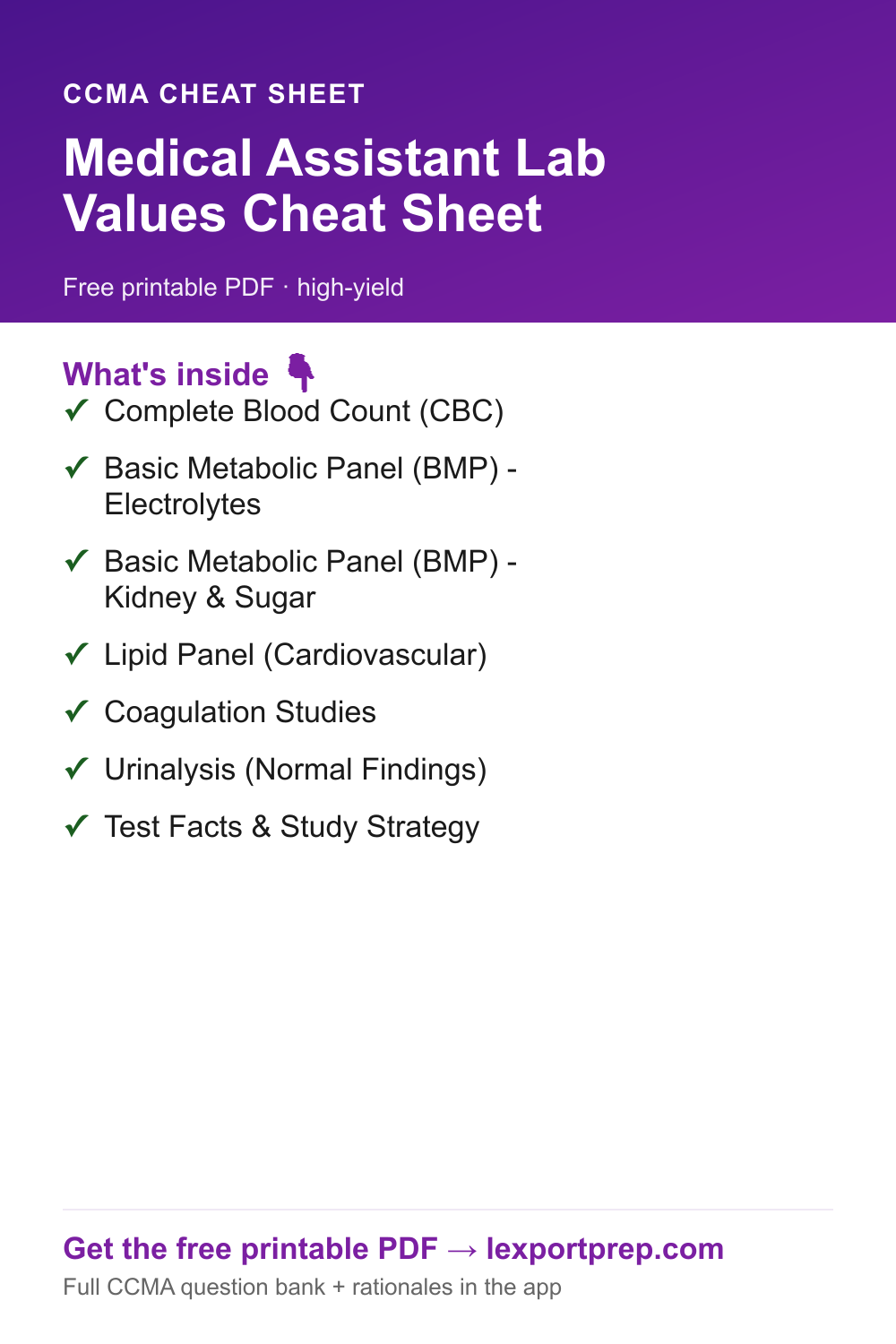
Medical Assistant Lab Values Cheat Sheet

Memorize these standard adult reference ranges for blood and urine tests. Clinical Patient Care makes up about 56% of your scored questions, so knowing these baseline values helps you flag abnormal results quickly.

2,300+

questions in the app

10+ yrs

exam-prep publishing

Free

on iOS & Android

Built to help you pass faster β€” by exam-prep publishers with 10+ years' experience

  • πŸ’‘ Key Takeaways β€” the one transferable rule per question
  • πŸ” Hint highlights β€” the decisive cue phrases in each stem
  • πŸ“– Full rationales β€” why every option is right or wrong

Every CCMA question is written to the current exam outline for quick learning and a clear pass strategy.

πŸ“„ Free: Medical Assistant Lab Values Cheat Sheet (PDF)

Enter your email and we'll send the printable PDF β€” rationales and key takeaways included.

Complete Blood Count (CBC)

White Blood Cells (WBC) β€” 4,500 to 11,000/mm3 / infection indicator Red Blood Cells (RBC) β€” 4.2 to 6.1 million/mm3 / oxygen transport Hemoglobin (Hgb) β€” 12 to 18 g/dL / varies by biological sex Hematocrit (Hct) β€” 37% to 52% / packed cell volume ratio Platelets β€” 150,000 to 400,000/mm3 / clotting function

Basic Metabolic Panel (BMP) - Electrolytes

Sodium (Na) β€” 135 to 145 mEq/L / fluid balance and nerve function Potassium (K) β€” 3.5 to 5.0 mEq/L / critical for cardiac rhythm Chloride (Cl) β€” 98 to 106 mEq/L / acid-base balance Calcium (Ca) β€” 8.5 to 10.5 mg/dL / bone health and muscle contraction

Basic Metabolic Panel (BMP) - Kidney & Sugar

Fasting Blood Glucose (FBG) β€” 70 to 99 mg/dL / diabetes screening Blood Urea Nitrogen (BUN) β€” 7 to 20 mg/dL / renal function indicator Creatinine β€” 0.6 to 1.2 mg/dL / kidney waste filtration

Lipid Panel (Cardiovascular)

Total Cholesterol β€” Less than 200 mg/dL / heart disease risk LDL (Low-Density Lipoprotein) β€” Less than 100 mg/dL / 'bad' cholesterol HDL (High-Density Lipoprotein) β€” Greater than 40 mg/dL / 'good' cholesterol Triglycerides β€” Less than 150 mg/dL / fat storage in blood

Coagulation Studies

Prothrombin Time (PT) β€” 11 to 13.5 seconds / clotting speed International Normalized Ratio (INR) β€” 0.8 to 1.1 / standardized PT for healthy adults INR (Therapeutic) β€” 2.0 to 3.0 / target range for patients on blood thinners

Urinalysis (Normal Findings)

Specific Gravity β€” 1.005 to 1.030 / urine concentration and hydration status pH β€” 4.5 to 8.0 / average is around 6.0 Protein β€” Negative / presence indicates potential kidney damage Glucose β€” Negative / presence suggests uncontrolled diabetes Ketones β€” Negative / presence indicates fat breakdown or starvation Leukocyte Esterase β€” Negative / presence suggests urinary tract infection

Test Facts & Study Strategy

Time limit β€” 180 minutes / total time to complete the test Question count β€” 180 total questions / 150 are scored Passing score β€” 390 out of 500 / scaled score requirement Recertification β€” Lapse over one year / requires retaking the NHA test Practice volume β€” 2300+ practice questions / available in our test bank

πŸ“Œ Save or share this CCMA cheat sheet
CCMA Medical Assistant Lab Values Cheat Sheet β€” free printable quick-reference chart

Can you apply it?

Knowing the sheet and using it are different things. Try these three CCMA practice questions on lab values. The app has 2,300+, timed and scored.

Question 1

A medical assistant has just collected three acceptable spirometry maneuvers from a patient. Upon reviewing the results, the assistant notes that the FVC values vary by more than 0.200 liters. Which of the following actions should the assistant take next?

β–Έ Why C is the answer

Spirometry requires both acceptability and reproducibility. Current guidelines state that the two largest FVC values must be within 0.150 liters of each other. Because the variance is over 0.200 liters, the results are not reproducible, and the assistant must perform additional maneuvers (up to a maximum of eight) until the values fall within acceptable limits. Option A is incorrect because spirometry relies on the highest values, never an average. Option B is unnecessary as calibration is a daily pre-test requirement, not a mid-test correction for patient variability. Option D is incorrect because accepting a single high value without reproducibility violates quality standards.

πŸ”‘ Key takeaway

Valid spirometry requires the two largest FVC and FEV1 values to be within 0.150 liters of each other.

Question 2

An adult patient requires a capillary blood glucose test. The medical assistant selects the left middle finger. To ensure an accurate and safe sample, how should the assistant align the lancet and collect the blood?

β–Έ Why B is the answer

Puncturing perpendicular to the fingerprint whorls ensures the blood forms a distinct, round drop rather than running down the natural grooves of the patient's finger. You must also always wipe away the first drop of blood with dry gauze. This initial drop contains interstitial fluid and residual alcohol, which can dilute the sample and cause inaccurate glucose readings. Collecting the first drop or cutting parallel to the whorls will compromise both the collection process and the test results.

πŸ”‘ Key takeaway

Puncture across the fingerprints and wipe the first drop to prevent sample contamination and ensure proper beading.

Question 3

An MA is preparing to apply a pediatric urine collection bag to a 10-month-old infant for a routine urinalysis. After cleaning the perineal area, what is the appropriate next step to ensure proper adhesion and prevent leakage?

β–Έ Why B is the answer

When applying a pediatric urine collection bag, the medical assistant must ensure the perineal area is completely dry after cleansing. Option B is correct because moisture prevents adhesion, causing the bag to leak or detach before a sufficient sample is collected. Option A is incorrect because barrier creams leave a greasy residue that completely inhibits the adhesive from sticking to the infant's skin. Option C is incorrect and potentially harmful; surgical tape can cause skin tears on delicate infant skin and is not the standard method for securing these bags. Option D is incorrect because a warm compress does not aid in adhesion and could potentially irritate the skin or compromise the adhesive material. Achieving a clean, dry surface is the most critical step for a successful pediatric urine collection.

πŸ”‘ Key takeaway

The skin must be completely dry before applying a pediatric urine bag to ensure proper adhesive seal.

Unlock all 2,325 CCMA practice questions, including 15 full-length mock exams

Timed, scored, with progress tracking and every answer explained. Free to start.

Practice the full CCMA bank in the app

You've seen a sample. Get the complete experience β€” a timed exam simulator, every rationale, and progress tracking that shows exactly what to study next.

This page shows a few free samples. The app has all 2,300+ CCMA questions, a timed mock exam, and offline study.

  • βœ“ 2,300+ real CCMA questions
  • βœ“ Timed exam simulator β€” real conditions
  • βœ“ Every answer explained + key takeaway
  • βœ“ Tracks your weak topics
  • βœ“ Works offline Β· Free to start

Get the full CCMA question bank β€” free

2,300+ practice questions with rationales on iOS & Android

CCMA Β· Exam Simulator

Sample exam question…

A) Option A
B) Option B
C) Option C
D) Option D
Submit Answer