ZQZionexIQ

Perioperative Medications Cheat Sheet

Review these essential medication classes, anesthesia agents, and safety rules. Pin or print this quick-reference guide to memorize key effects and red flags.

2,200+

questions in the app

10+ yrs

exam-prep publishing

Free

on iOS & Android

Built to help you pass faster β€” by exam-prep publishers with 10+ years' experience

  • πŸ’‘ Key Takeaways β€” the one transferable rule per question
  • πŸ” Hint highlights β€” the decisive cue phrases in each stem
  • πŸ“– Full rationales β€” why every option is right or wrong

Every CNOR question is written to the current exam outline for quick learning and a clear pass strategy.

πŸ“„ Free: Perioperative Medications Cheat Sheet (PDF)

Enter your email and we'll send the printable PDF β€” rationales and key takeaways included.

Inhalation Anesthetics (Volatile Agents)

Isoflurane / Sevoflurane / Desflurane β€” volatile liquids, potent triggers for malignant hyperthermia (MH). Nitrous Oxide β€” weak anesthetic but strong analgesic, expands in closed air spaces (avoid in bowel obstruction, pneumothorax, or middle ear surgery). Halothane β€” rarely used in modern practice, carries high risk of hepatotoxicity and MH.

Intravenous Induction Agents

Propofol β€” rapid onset and recovery, causes hypotension and respiratory depression, requires strict aseptic technique (lipid emulsion supports bacterial growth). Etomidate β€” minimal cardiovascular depression, ideal for hemodynamically unstable patients, can cause myoclonus and adrenal suppression. Ketamine β€” dissociative anesthesia, provides analgesia, increases heart rate and blood pressure, carries risk of emergence delirium. Dexmedetomidine β€” alpha-2 agonist, provides sedation and analgesia without significant respiratory depression, monitor for bradycardia.

Neuromuscular Blocking Agents (NMBAs)

Succinylcholine β€” depolarizing agent, rapid onset, triggers malignant hyperthermia, causes transient hyperkalemia (contraindicated in severe burns or crush injuries). Rocuronium / Vecuronium β€” non-depolarizing agents, reversed by neostigmine or sugammadex, no MH risk. Cisatracurium β€” non-depolarizing agent, undergoes Hofmann elimination (organ-independent clearance), ideal for patients with renal or hepatic impairment.

Reversal Agents

Naloxone β€” reverses opioid-induced respiratory depression, short half-life requires close monitoring for re-sedation. Flumazenil β€” reverses benzodiazepines, carries risk of seizures in chronic benzodiazepine users. Neostigmine β€” reverses non-depolarizing NMBAs, must be administered with an anticholinergic (glycopyrrolate or atropine) to prevent severe bradycardia. Sugammadex β€” selectively encapsulates and reverses rocuronium and vecuronium, renders hormonal contraceptives ineffective for seven days.

Local Anesthetics

Lidocaine / Bupivacaine / Ropivacaine β€” block nerve conduction, always monitor for Local Anesthetic Systemic Toxicity (LAST). Epinephrine additive β€” prolongs anesthetic block duration and decreases systemic absorption, avoid in end-artery areas (fingers, toes, nose, penis). LAST symptoms β€” perioral numbness, metallic taste, tinnitus, agitation, seizures, progressing to cardiovascular collapse. LAST treatment β€” immediately stop injection, secure the airway, and administer 20% lipid emulsion therapy.

Analgesics & Adjuncts

Fentanyl / Sufentanil β€” synthetic opioids, rapid onset, cause respiratory depression and chest wall rigidity if pushed too rapidly. Midazolam β€” short-acting benzodiazepine, provides amnesia and anxiolysis, monitor for respiratory depression. Ondansetron β€” serotonin antagonist, prevents postoperative nausea and vomiting (PONV), can prolong the QT interval. Dexamethasone β€” corticosteroid, used as an antiemetic and anti-inflammatory adjunct, may increase postoperative blood glucose levels.

High-Alert Perioperative Medications

Heparin β€” anticoagulant used in vascular procedures, reversed by protamine sulfate, monitor Activated Clotting Time (ACT). Protamine Sulfate β€” heparin reversal agent, carries risk of severe hypotension and anaphylaxis (higher risk in patients with fish allergies or prior vasectomy). Dantrolene β€” direct-acting muscle relaxant, the only specific treatment for malignant hyperthermia, requires rapid reconstitution with sterile water. Tranexamic Acid (TXA) β€” antifibrinolytic, prevents clot breakdown to reduce surgical bleeding, monitor for thromboembolic events.
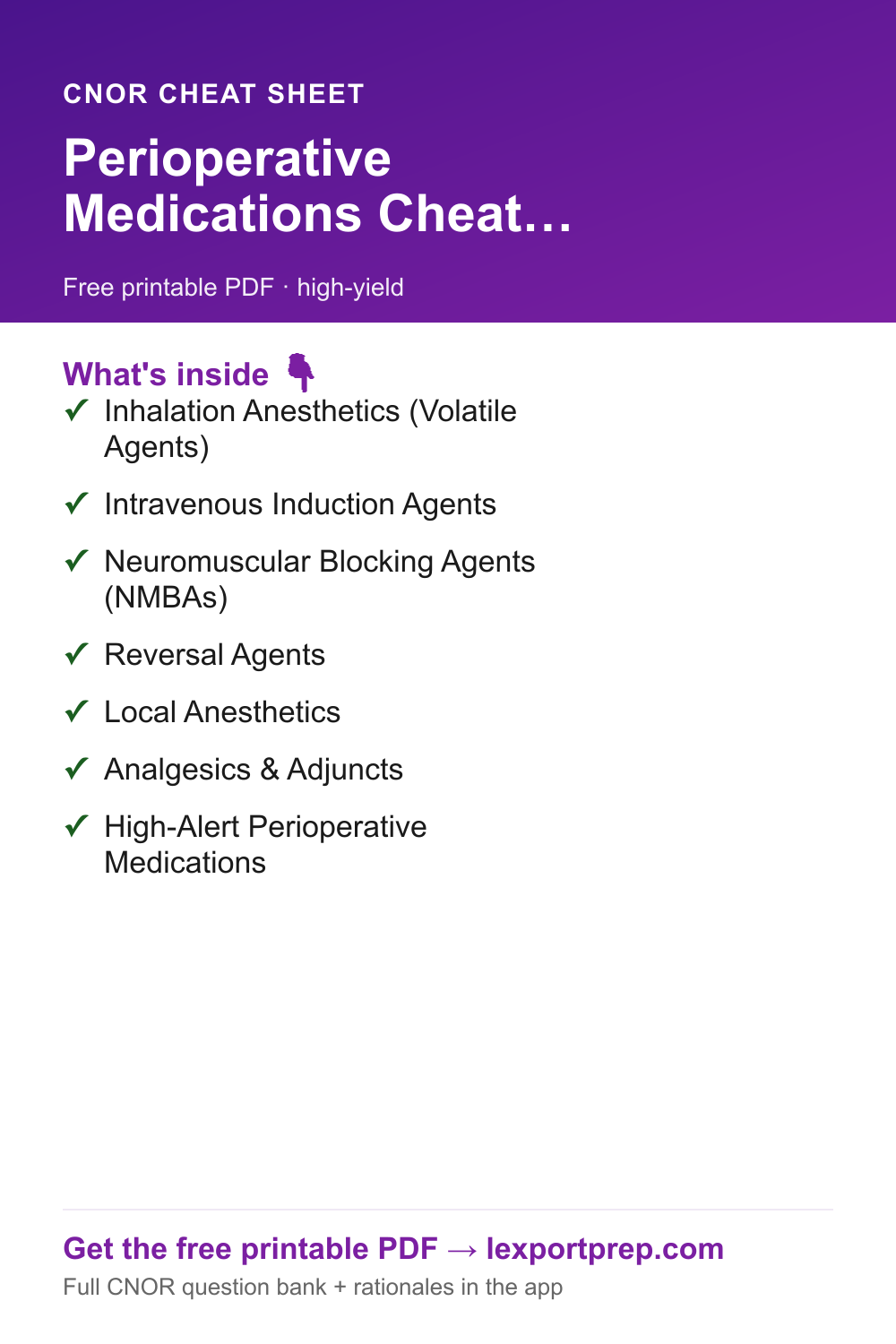
πŸ“Œ Save or share this CNOR cheat sheet
CNOR Perioperative Medications Cheat Sheet β€” free printable quick-reference chart

Can you apply it?

Knowing the sheet and using it are different things. Try these three CNOR practice questions on medications. The app has 2,200+, timed and scored.

Question 1

During an open abdominal hysterectomy, the surgeon requests 0.25% bupivacaine with epinephrine for local infiltration. The circulating nurse prepares to transfer the medication to the sterile field. Which action by the surgical technologist represents an appropriate scope of practice?

β–Έ Why A is the answer

When delegating tasks to a surgical technologist, the perioperative nurse must understand the legal boundaries of unlicensed assistive personnel. In this scenario, the technologist can safely accept the medication onto the sterile field and must participate in verbally verifying the drug name, strength, and expiration date with the nurse. However, injecting local anesthetics into the patient is strictly a provider function and outside the technologist's scope. Documenting the total volume in the official perioperative nursing record is a nursing responsibility, as is assessing the patient for any physiological reactions like systemic toxicity. The nurse retains accountability for the medication until it is handed to the surgeon, making verbal verification the only appropriate and legally sound action for the technologist to perform in this context.

πŸ”‘ Key takeaway

Surgical technologists can verify and accept medications onto the sterile field but cannot administer or document them.

Question 2

The nurse is administering an unverified emergency medication to a patient during a sudden power and system failure. How should this intervention be documented?

β–Έ Why A is the answer

In an emergency combined with a system failure, accurate documentation of medication administration is critical to prevent overdose or duplicate dosing. The nurse must immediately document the medication administration on the approved downtime form. Option B is highly unsafe because high-stress situations severely impair memory, making it likely the nurse will forget exact dosages or administration times before the system recovers. Option C is incorrect because a sterile drape is not a permanent or legal record, and the information will be lost when the room is turned over. Option D inappropriately shifts the documentation burden to the scrub person, who is focused on maintaining the sterile field and assisting the surgeon. Using the official downtime form ensures a permanent, accurate record is maintained for later electronic reconciliation.

πŸ”‘ Key takeaway

Emergency medications administered during an outage must be immediately recorded on approved downtime documentation forms.

Question 3

A 50-kg patient is scheduled for multiple lipoma excisions. The surgeon plans to use 1% lidocaine with 1:200,000 epinephrine. To prevent systemic toxicity, the perioperative nurse should verify that the total volume administered does not exceed which threshold?

β–Έ Why C is the answer

The maximum safe dose of lidocaine with epinephrine is 7 mg/kg. For a 50-kg patient, the total allowable dose is 350 mg. A 1% lidocaine solution contains 10 mg per milliliter. Dividing the total dose of 350 mg by 10 mg/mL yields a maximum volume of 35 mL. Option A (25 mL) and Option B (30 mL) are under the maximum limit but do not represent the actual threshold. Option D (40 mL) would deliver 400 mg, exceeding the safe limit and increasing the risk of toxicity.

πŸ”‘ Key takeaway

The maximum safe dose for lidocaine with epinephrine is 7 mg/kg.

Unlock all 2,217 CNOR practice questions, including 11 full-length mock exams

Timed, scored, with progress tracking and every answer explained. Free to start.

Practice the full CNOR bank in the app

You've seen a sample. Get the complete experience β€” a timed exam simulator, every rationale, and progress tracking that shows exactly what to study next.

This page shows a few free samples. The app has all 2,200+ CNOR questions, a timed mock exam, and offline study.

  • βœ“ 2,200+ real CNOR questions
  • βœ“ Timed exam simulator β€” real conditions
  • βœ“ Every answer explained + key takeaway
  • βœ“ Tracks your weak topics
  • βœ“ Works offline Β· Free to start

Get the full CNOR question bank β€” free

2,200+ practice questions with rationales on iOS

CNOR Β· Exam Simulator

Sample exam question…

A) Option A
B) Option B
C) Option C
D) Option D
Submit Answer