ZQZionexIQ

Pediatric Lab Values Cheat Sheet for the CPN Exam

Memorize these standard pediatric lab ranges and how they differ from adult values to tackle the Assessment domain. Print or pin this guide for quick review during your study sessions.

2,200+

questions in the app

10+ yrs

exam-prep publishing

Free

on iOS & Android

Built to help you pass faster β€” by exam-prep publishers with 10+ years' experience

  • πŸ’‘ Key Takeaways β€” the one transferable rule per question
  • πŸ” Hint highlights β€” the decisive cue phrases in each stem
  • πŸ“– Full rationales β€” why every option is right or wrong

Every CPN question is written to the current exam outline for quick learning and a clear pass strategy.

πŸ“„ Free: Pediatric Lab Values Cheat Sheet for the CPN Exam (PDF)

Enter your email and we'll send the printable PDF β€” rationales and key takeaways included.

Complete Blood Count (CBC)

Hemoglobin (Newborn) β€” 14 to 24 g/dL / Much higher than adults due to fetal hemoglobin. Hemoglobin (Infant) β€” 10 to 15 g/dL / Drops as fetal RBCs break down (physiologic anemia). Hemoglobin (Child) β€” 11 to 16 g/dL / Gradually approaches adult levels. WBC Count (Newborn) β€” 9,000 to 30,000/mm3 / Elevated at birth is normal, drops rapidly. WBC Count (Child) β€” 5,000 to 10,000/mm3 / Mirrors standard adult ranges. Platelets β€” 150,000 to 400,000/mm3 / Consistent across pediatric and adult populations.

Basic Metabolic Panel (Electrolytes)

Sodium (Na) β€” 135 to 145 mEq/L / Same as adults; critical for hydration status. Potassium (K) (Infant) β€” 4.1 to 5.3 mEq/L / Slightly higher than adults; monitor closely with IV fluids. Potassium (K) (Child) β€” 3.4 to 4.7 mEq/L / Approaches adult norms; critical for cardiac function. Calcium (Total) β€” 8.8 to 10.8 mg/dL / Slightly higher in children due to active bone growth. Chloride (Cl) β€” 98 to 106 mEq/L / Mirrors adult ranges; shifts with sodium and acid-base balance.

Renal Function & Urinalysis

BUN (Infant/Child) β€” 5 to 18 mg/dL / Lower than adults due to smaller muscle mass and protein intake. Creatinine (Infant) β€” 0.2 to 0.4 mg/dL / Very low compared to adults; rises with muscle development. Creatinine (Child) β€” 0.3 to 0.7 mg/dL / Any value over 1.0 mg/dL in a young child requires urgent evaluation. Urine Specific Gravity β€” 1.005 to 1.030 / High indicates dehydration; infants cannot concentrate urine well. Urine Output (Infant) β€” 2 mL/kg/hr / Standard minimum for adequate hydration. Urine Output (Child) β€” 1 to 2 mL/kg/hr / Standard minimum; drops to 0.5 to 1 mL/kg/hr in adolescents.

Liver Function & Coagulation

Bilirubin (Total, Newborn) β€” 1 to 12 mg/dL / Peaks around day 3-5; levels >15 mg/dL often need phototherapy. Bilirubin (Total, Child) β€” 0.2 to 1.0 mg/dL / Matches adult levels once newborn jaundice resolves. AST/ALT β€” Varies by age / Generally higher in infants, settling to adult norms by late childhood. PT/PTT (Newborn) β€” Prolonged / Liver is immature; vitamin K given at birth prevents hemorrhagic disease.

Acid-Base Balance (ABGs)

pH (Child) β€” 7.35 to 7.45 / Same as adults; strict window for cellular function. PaCO2 (Child) β€” 35 to 45 mmHg / Respiratory component; infants decompensate quickly with respiratory distress. HCO3 (Infant/Child) β€” 20 to 28 mEq/L / Metabolic component; lower end is normal for infants compared to adults. PaO2 (Child) β€” 80 to 100 mmHg / Measured on room air; critical for assessing oxygenation.

CPN Exam Structure & Strategy

Assessment Domain β€” 35% of the exam (53 items) / Heavy focus on recognizing abnormal labs and baseline norms. Exam Format β€” 175 total questions (150 scored) / Fixed-form test, you have 180 minutes to finish. Pass Rate β€” Roughly 76-77% in 2022-2023 / Prepare thoroughly for all domains. Study Strategy β€” 2200+ practice questions / Drill these values in our bank to build rapid recognition.

πŸ“Œ Save or share this CPN cheat sheet
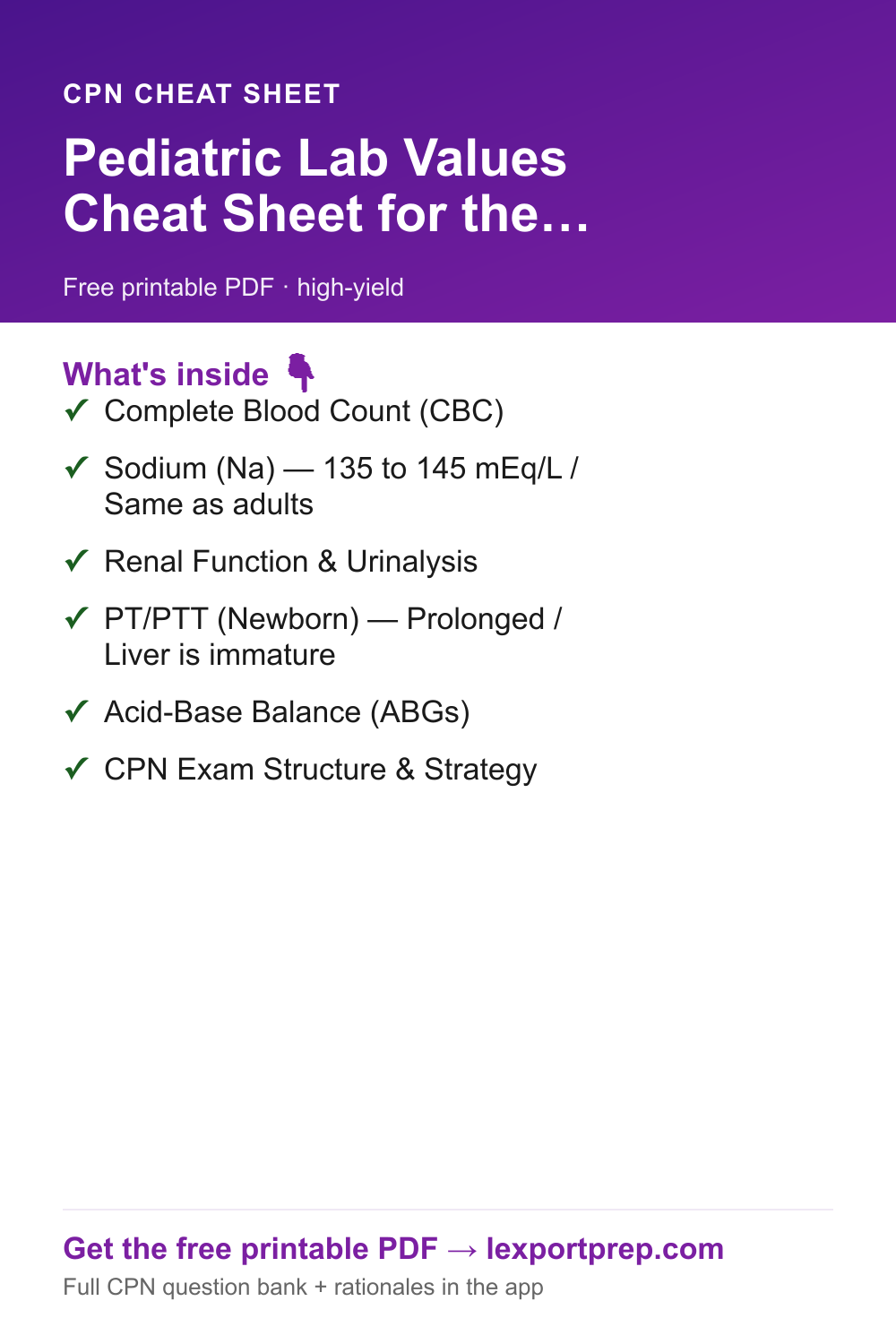
CPN Pediatric Lab Values Cheat Sheet for the CPN Exam β€” free printable quick-reference chart

Can you apply it?

Knowing the sheet and using it are different things. Try these three CPN practice questions on lab values. The app has 2,200+, timed and scored.

Question 1

A 12-year-old with newly diagnosed type 1 diabetes is in the clinic. The family wants to use a smartphone app to track blood glucose and carbohydrate counting. What is the most appropriate action before recommending a specific application?

β–Έ Why A is the answer

When recommending digital health tools for chronic condition management, the nurse must first ensure the application adheres to strict data privacy laws and utilizes evidence-based guidelines. Option A is the best choice because protecting health information and ensuring medical accuracy are foundational safety requirements. Option B is incorrect; while gamification can certainly enhance engagement for an adolescent, it is a secondary priority compared to clinical safety and privacy. Option C is incorrect because direct provider messaging is not a mandatory feature for a tracking app and is often logistically impossible for standard clinic workflows. Option D is incorrect because a 12-year-old needs an interactive tool to foster independence in their own care, rather than relying on passive video tutorials designed solely for their parents.

πŸ”‘ Key takeaway

Digital health tools must be vetted for patient data privacy and clinical accuracy before recommendation.

Question 2

A child's cerebrospinal fluid analysis returns with a normal glucose level, mildly elevated protein, and a lymphocytic pleocytosis. Which plan of care is most appropriate for this patient?

β–Έ Why C is the answer

A cerebrospinal fluid profile showing a normal glucose level and lymphocytic pleocytosis is a classic presentation for viral meningitis, which generally requires supportive care such as hydration and antipyretics. Option A is incorrect because bacterial meningitis typically presents with low glucose and a predominance of neutrophils, warranting strict droplet precautions. Option B and Option D are aggressive interventions meant for severe intracranial pressure or hydrocephalus, which are not indicated by this standard viral fluid profile in a stable patient.

πŸ”‘ Key takeaway

Viral meningitis presents with normal glucose and lymphocytic pleocytosis and is managed with supportive care.

Question 3

A 6-year-old child with type 1 diabetes is found unresponsive with generalized tremors. A capillary blood glucose reading is 42 mg/dL. Which action should the nurse take?

β–Έ Why B is the answer

When a child is unresponsive or seizing from severe hypoglycemia, they cannot safely swallow oral carbohydrates. Option B is the best choice because intramuscular glucagon stimulates hepatic glycogenolysis to rapidly raise blood sugar, and placing the child in a lateral recovery position protects the airway from aspiration, as glucagon frequently induces vomiting. Option A and Option C are dangerous because administering oral fluids or gels to an unresponsive patient creates a high risk for aspiration. Option D is incorrect because epinephrine is used for anaphylaxis, not hypoglycemia; while it can raise blood sugar slightly through stress response mechanisms, it is not the standard or effective treatment for insulin-induced hypoglycemia.

πŸ”‘ Key takeaway

Unconscious hypoglycemia requires immediate intramuscular glucagon administration and lateral positioning to prevent aspiration from emesis.

Unlock all 2,232 CPN practice questions, including 15 full-length mock exams

Timed, scored, with progress tracking and every answer explained. Free to start.

Practice the full CPN bank in the app

You've seen a sample. Get the complete experience β€” a timed exam simulator, every rationale, and progress tracking that shows exactly what to study next.

This page shows a few free samples. The app has all 2,200+ CPN questions, a timed mock exam, and offline study.

β˜…β˜…β˜…β˜…β˜…5.0 Β· 7 App Store ratings
  • βœ“ 2,200+ real CPN questions
  • βœ“ Timed exam simulator β€” real conditions
  • βœ“ Every answer explained + key takeaway
  • βœ“ Tracks your weak topics
  • βœ“ Works offline Β· Free to start

Get the full CPN question bank β€” free

2,200+ practice questions with rationales on iOS & Android

CPN Β· Exam Simulator

Sample exam question…

A) Option A
B) Option B
C) Option C
D) Option D
Submit Answer