ZQZionexIQ

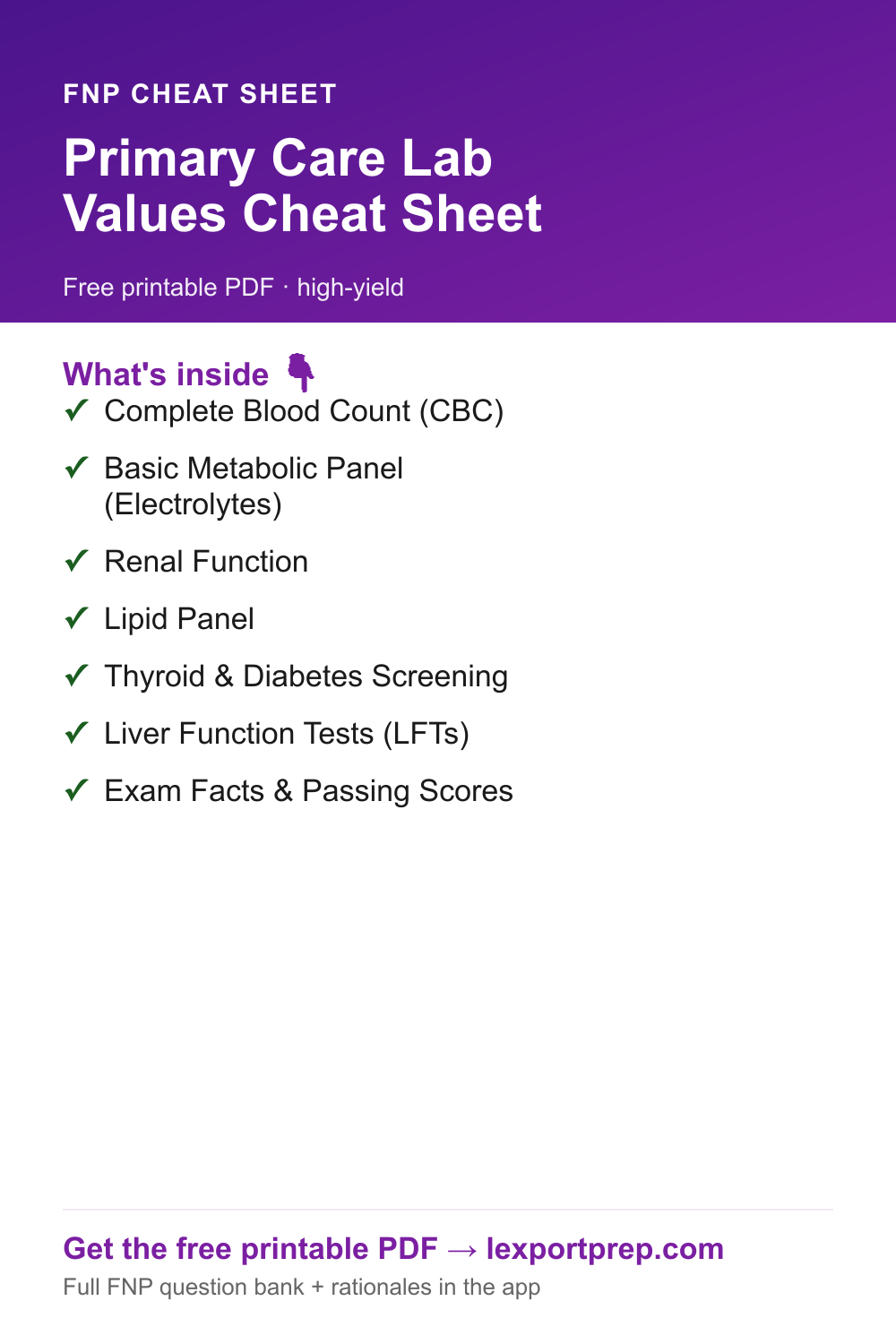
Primary Care Lab Values Cheat Sheet

Memorize these standard adult lab reference ranges for your certification exam. Print or save this quick-reference guide to drill essential primary care values.

3,000+

questions in the app

10+ yrs

exam-prep publishing

Free

on iOS & Android

Built to help you pass faster β€” by exam-prep publishers with 10+ years' experience

  • πŸ’‘ Key Takeaways β€” the one transferable rule per question
  • πŸ” Hint highlights β€” the decisive cue phrases in each stem
  • πŸ“– Full rationales β€” why every option is right or wrong

Every FNP question is written to the current exam outline for quick learning and a clear pass strategy.

πŸ“„ Free: Primary Care Lab Values Cheat Sheet (PDF)

Enter your email and we'll send the printable PDF β€” rationales and key takeaways included.

Complete Blood Count (CBC)

WBC β€” 4,500 to 11,000 cells/mcL / indicates infection or immunosuppression Hemoglobin (Male) β€” 13.5 to 17.5 g/dL / screens for anemia or bleeding Hemoglobin (Female) β€” 12.0 to 15.5 g/dL / screens for anemia or bleeding Hematocrit (Male) β€” 41% to 50% / measures proportion of red blood cells Hematocrit (Female) β€” 36% to 48% / measures proportion of red blood cells Platelets β€” 150,000 to 450,000/mcL / crucial for clotting and bleeding risk

Basic Metabolic Panel (Electrolytes)

Sodium (Na) β€” 135 to 145 mEq/L / critical for fluid balance and neuro function Potassium (K) β€” 3.5 to 5.0 mEq/L / essential for cardiac conduction Calcium (Ca) β€” 8.5 to 10.2 mg/dL / vital for muscle contraction and bone health Chloride (Cl) β€” 96 to 106 mEq/L / maintains acid-base balance Magnesium (Mg) β€” 1.7 to 2.2 mg/dL / low levels trigger cardiac arrhythmias

Renal Function

BUN (Blood Urea Nitrogen) β€” 8 to 20 mg/dL / evaluates kidney function and hydration Creatinine (Male) β€” 0.7 to 1.3 mg/dL / primary indicator of renal impairment Creatinine (Female) β€” 0.6 to 1.1 mg/dL / primary indicator of renal impairment GFR (Glomerular Filtration Rate) β€” >90 mL/min/1.73m2 / defines chronic kidney disease stages

Lipid Panel

Total Cholesterol β€” <200 mg/dL / baseline marker for cardiovascular risk LDL (Low-Density Lipoprotein) β€” <100 mg/dL / optimal target for healthy adults HDL (High-Density Lipoprotein) β€” >40 mg/dL (Male) or >50 mg/dL (Female) / cardioprotective cholesterol Triglycerides β€” <150 mg/dL / elevated levels increase pancreatitis risk

Thyroid & Diabetes Screening

TSH (Thyroid Stimulating Hormone) β€” 0.4 to 4.0 mIU/L / first-line test for thyroid dysfunction Free T4 β€” 0.8 to 1.8 ng/dL / confirms hyperthyroidism or hypothyroidism Fasting Blood Glucose β€” 70 to 99 mg/dL / screens for prediabetes and diabetes Hemoglobin A1c (Normal) β€” <5.7% / reflects 90-day average blood glucose Hemoglobin A1c (Diabetes) β€” β‰₯6.5% / diagnostic threshold for diabetes mellitus

Liver Function Tests (LFTs)

ALT (Alanine Aminotransferase) β€” 7 to 56 U/L / highly specific to liver injury AST (Aspartate Aminotransferase) β€” 10 to 40 U/L / indicates liver, heart, or muscle damage ALP (Alkaline Phosphatase) β€” 44 to 147 U/L / elevated in biliary obstruction or bone disease Total Bilirubin β€” 0.1 to 1.2 mg/dL / causes jaundice when significantly elevated

Exam Facts & Passing Scores

AANP FNP-C Passing Score β€” 500 / scaled from 200 to 800 ANCC FNP-BC Passing Score β€” 350 / scaled from 0 to 500 Recertification β€” Every 5 years / requires continuing education or re-examination Practice Bank β€” 3000+ practice questions / use these to drill lab value scenarios

πŸ“Œ Save or share this FNP cheat sheet
FNP Primary Care Lab Values Cheat Sheet β€” free printable quick-reference chart

Can you apply it?

Knowing the sheet and using it are different things. Try these three FNP practice questions on lab values. The app has 3,000+, timed and scored.

Question 1

A 71-year-old patient with severe osteoarthritis of the hip reports debilitating pain. Laboratory results reveal an eGFR of 28 mL/min/1.73 m2, and the patient has a history of gastrointestinal bleeding. Which pain management strategy is most appropriate?

β–Έ Why D is the answer

Patients with severe chronic kidney disease and a history of gastrointestinal bleeding have strict contraindications to systemic therapies. Intra-articular corticosteroids offer targeted relief without systemic toxicity. Both naproxen and celecoxib are NSAIDs that will worsen renal impairment and increase bleeding risk. Duloxetine is contraindicated in patients with an eGFR below 30 mL/min/1.73 m2 due to decreased clearance and increased toxicity.

πŸ”‘ Key takeaway

Intra-articular injections provide localized pain relief safely when systemic agents are contraindicated by severe renal impairment.

Question 2

A 42-year-old male returns to the clinic to review his recent laboratory results. He has a body mass index of 29.1 and no other medical conditions. His fasting lipid panel is normal, and his hemoglobin A1c is 5.2%. What should the nurse practitioner recommend regarding future diabetes screening?

β–Έ Why D is the answer

For adults who are overweight or obese and undergo screening for type 2 diabetes, guidelines recommend repeating the screening at least every three years if the initial results are normal. This patient's hemoglobin A1c is 5.2%, which is well within the normal range. Repeating the test in six months, one year, or two years is unnecessary and increases healthcare costs without clinical benefit, assuming his risk profile and clinical status remain stable. Routine clinical monitoring should continue, but formal screening is safely deferred for three years.

πŸ”‘ Key takeaway

Normal diabetes screening results in overweight adults should be repeated every three years.

Question 3

A 58-year-old asymptomatic female born in 1965 undergoes routine screening. Her laboratory results show a positive anti-HCV antibody with normal ALT and AST levels. Based on these specific findings, what is the most appropriate next step in management?

β–Έ Why C is the answer

A positive anti-HCV antibody indicates prior exposure to the hepatitis C virus but cannot differentiate between an active chronic infection and a past resolved infection. Therefore, ordering a quantitative HCV RNA test is the essential next step to confirm current viral replication. Option A is incorrect because normal transaminases do not rule out active hepatitis C; many patients with chronic infection maintain normal liver enzymes. Option B is premature and overly invasive before confirming active viremia and considering non-invasive fibrosis staging. Option D is incorrect because direct-acting antiviral therapy should never be initiated based solely on an antibody test without confirming the presence of viral RNA.

πŸ”‘ Key takeaway

A positive anti-HCV antibody requires follow-up with an HCV RNA test to confirm active viral infection.

Unlock all 3,030 FNP practice questions, including 20 full-length mock exams

Timed, scored, with progress tracking and every answer explained. Free to start.

Practice the full FNP bank in the app

You've seen a sample. Get the complete experience β€” a timed exam simulator, every rationale, and progress tracking that shows exactly what to study next.

This page shows a few free samples. The app has all 3,000+ FNP questions, a timed mock exam, and offline study.

  • βœ“ 3,000+ real FNP questions
  • βœ“ Timed exam simulator β€” real conditions
  • βœ“ Every answer explained + key takeaway
  • βœ“ Tracks your weak topics
  • βœ“ Works offline Β· Free to start

Get the full FNP question bank β€” free

3,000+ practice questions with rationales on iOS

FNP Β· Exam Simulator

Sample exam question…

A) Option A
B) Option B
C) Option C
D) Option D
Submit Answer