ZQZionexIQ

CMSRN Lab Values Cheat Sheet

Print or save this quick-reference guide to standard adult lab values. Use it to memorize normal ranges and identify critical abnormalities on the test.

5,200+

questions in the app

10+ yrs

exam-prep publishing

Free

on iOS & Android

Built to help you pass faster β€” by exam-prep publishers with 10+ years' experience

  • πŸ’‘ Key Takeaways β€” the one transferable rule per question
  • πŸ” Hint highlights β€” the decisive cue phrases in each stem
  • πŸ“– Full rationales β€” why every option is right or wrong

Every CMSRN question is written to the current exam outline for quick learning and a clear pass strategy.

πŸ“„ Free: CMSRN Lab Values Cheat Sheet (PDF)

Enter your email and we'll send the printable PDF β€” rationales and key takeaways included.

Electrolytes (Basic Metabolic Panel)

Sodium (Na) β€” 135-145 mEq/L / Assess hydration and neurological status. Potassium (K) β€” 3.5-5.0 mEq/L / Critical for cardiac rhythm; monitor with diuretics. Calcium (Ca) β€” 8.5-10.5 mg/dL / Watch for tetany (low) or muscle weakness (high). Magnesium (Mg) β€” 1.5-2.5 mEq/L / Low levels trigger deep tendon reflex hyperactivity. Chloride (Cl) β€” 98-106 mEq/L / Shifts alongside sodium and acid-base imbalances. Phosphorus (PO4) β€” 2.5-4.5 mg/dL / Has an inverse relationship with calcium levels.

Hematology (Complete Blood Count)

White Blood Cells (WBC) β€” 5,000-10,000/mm3 / Elevated in infection; low in immunosuppression. Hemoglobin (Hgb) β€” Male: 14-18 g/dL, Female: 12-16 g/dL / Indicates oxygen-carrying capacity. Hematocrit (Hct) β€” Male: 42-52%, Female: 37-47% / Usually three times the hemoglobin value. Platelets (Plt) β€” 150,000-400,000/mm3 / Below 100,000 indicates thrombocytopenia and bleeding risk.

Renal Function & Urinalysis

Blood Urea Nitrogen (BUN) β€” 10-20 mg/dL / Elevated in dehydration or renal impairment. Creatinine β€” 0.6-1.2 mg/dL / The most specific indicator of kidney function. Urine Specific Gravity β€” 1.005-1.030 / High means concentrated urine; low means dilute.

Coagulation Studies

Prothrombin Time (PT) β€” 11-12.5 seconds / Used to monitor warfarin therapy. International Normalized Ratio (INR) β€” 0.8-1.1 (Normal) / Therapeutic for warfarin is typically 2.0-3.0. Partial Thromboplastin Time (aPTT) β€” 30-40 seconds / Used to monitor heparin; therapeutic is 1.5-2x normal.

Hepatic Function & Pancreas

Alanine Aminotransferase (ALT) β€” 4-36 units/L / Specific to liver damage. Aspartate Aminotransferase (AST) β€” 0-35 units/L / Rises with liver or muscle tissue damage. Total Bilirubin β€” 0.3-1.0 mg/dL / Elevated levels cause jaundice and indicate liver dysfunction. Amylase β€” 30-220 units/L / Rises rapidly in acute pancreatitis. Lipase β€” 0-160 units/L / More specific to pancreatic damage than amylase.

Cardiac & Inflammatory Markers

Troponin I β€” <0.03 ng/mL / Gold standard for detecting myocardial infarction. Brain Natriuretic Peptide (BNP) β€” <100 pg/mL / Elevated values indicate heart failure. C-Reactive Protein (CRP) β€” <1.0 mg/dL / General marker for systemic inflammation.

Arterial Blood Gases (ABGs)

pH β€” 7.35-7.45 / Determines overall acid-base status. PaCO2 β€” 35-45 mmHg / The respiratory component; inverse relationship with pH. HCO3 β€” 22-26 mEq/L / The metabolic component; direct relationship with pH. PaO2 β€” 80-100 mmHg / Measures oxygen dissolved in arterial blood.

Exam Facts to Remember

Passing Score β€” 95 / This is a standard scaled score, requiring about 71% correct. Scored Questions β€” 125 items / You must apply these lab values across five official domains. Largest Domain β€” Patient/Care Management / Makes up 32% (40 items) of the test. Recertification β€” Every 5 years / Requires 90 contact hours or re-examination. Practice β€” 5213 practice questions / Use our bank to test your clinical application of these values.
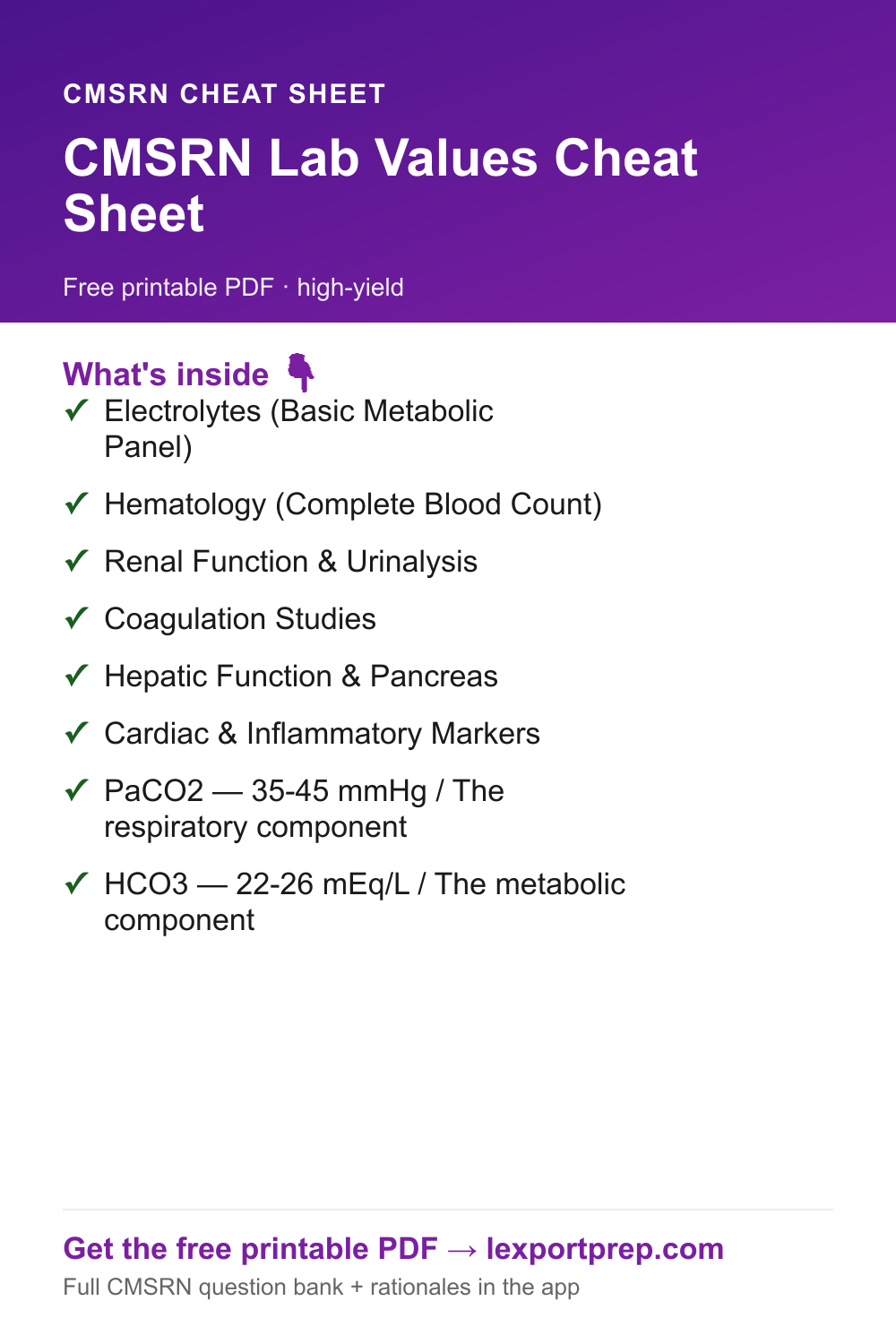
πŸ“Œ Save or share this CMSRN cheat sheet
CMSRN Lab Values Cheat Sheet β€” free printable quick-reference chart

Can you apply it?

Knowing the sheet and using it are different things. Try these three CMSRN practice questions on lab values. The app has 5,200+, timed and scored.

Question 1

A diabetic patient with stage 3 CKD demonstrates wound care techniques perfectly but states, "I'll skip my insulin if my morning sugar is under 100." Pre-education assessment revealed hemoglobin A1c of 9.2%. Which learning outcome evaluation is most compromised?

β–Έ Why B is the answer

The patient's statement reveals dangerous misunderstanding of insulin management (discriminating cue: CKD increases hypoglycemia risk). Option B directly addresses this misconception, which is critical given the elevated A1c. Option A was successfully demonstrated per scenario. Option C (infection signs) is important but unrelated to the expressed misconception. Option D (monitoring ability) isn't questioned in the scenario. AMSN protocols emphasize evaluating comprehension of treatment modifications for comorbidities over isolated skill performance.

Question 2

A 62-year-old with diabetes and dysphagia post-stroke begins continuous enteral feeding via nasogastric tube. After 4 hours, the nurse notes blood glucose of 210 mg/dL and gastric residual volume of 300 mL. Which intervention best addresses both findings?

β–Έ Why D is the answer

Elevated residual requires monitoring per ASPEN guidelines (recheck in 1 hour before altering nutrition), while hyperglycemia needs insulin to avoid underfeeding. Reducing formula (A) risks inadequate nutrition without addressing hyperglycemia. Holding feeds (B) may cause hypoglycemia and doesn't manage glucose. Bolus feeds (C) increase aspiration risk in dysphagia and may worsen glycemic control. Continuing feeds with close monitoring (D) maintains nutrition support while treating hyperglycemia.

Question 3

A Jehovah's Witness patient with acute anemia refuses blood transfusion despite hemoglobin of 6.8 g/dL, stating it conflicts with religious beliefs. The healthcare team questions her decision-making capacity due to anemia-related fatigue. Which nursing action best upholds ethical informed consent principles?

β–Έ Why C is the answer

Religious refusal must be honored unless clear incapacity exists. Fatigue alone doesn't invalidate capacity; assessing understanding while respecting beliefs aligns with autonomy. Option A violates refusal and misapplies implied consent. Option B undermines autonomy by presuming incapacity without assessment. Option D ignores the patient's competent expression of values. The religious conviction and anemia severity require careful capacity evaluation before overriding decisions.

Unlock all 5,213 CMSRN practice questions, including 37 full-length mock exams

Timed, scored, with progress tracking and every answer explained. Free to start.

Practice the full CMSRN bank in the app

You've seen a sample. Get the complete experience β€” a timed exam simulator, every rationale, and progress tracking that shows exactly what to study next.

This page shows a few free samples. The app has all 5,200+ CMSRN questions, a timed mock exam, and offline study.

β˜…β˜…β˜…β˜…β˜…4.6 Β· 22 App Store ratings
  • βœ“ 5,200+ real CMSRN questions
  • βœ“ Timed exam simulator β€” real conditions
  • βœ“ Every answer explained + key takeaway
  • βœ“ Tracks your weak topics
  • βœ“ Works offline Β· Free to start

Get the full CMSRN question bank β€” free

5,200+ practice questions with rationales on iOS & Android

CMSRN Β· Exam Simulator

Sample exam question…

A) Option A
B) Option B
C) Option C
D) Option D
Submit Answer