ZQZionexIQ

CMSRN Medications Cheat Sheet

Review these high-yield medication classes before test day. Focus on nursing considerations and red-flag side effects you will see on the medical-surgical floor.

5,200+

questions in the app

10+ yrs

exam-prep publishing

Free

on iOS & Android

Built to help you pass faster β€” by exam-prep publishers with 10+ years' experience

  • πŸ’‘ Key Takeaways β€” the one transferable rule per question
  • πŸ” Hint highlights β€” the decisive cue phrases in each stem
  • πŸ“– Full rationales β€” why every option is right or wrong

Every CMSRN question is written to the current exam outline for quick learning and a clear pass strategy.

πŸ“„ Free: CMSRN Medications Cheat Sheet (PDF)

Enter your email and we'll send the printable PDF β€” rationales and key takeaways included.

Cardiovascular Medications

Beta-Blockers (-olol) β€” Monitor heart rate and blood pressure; hold for bradycardia; watch for bronchospasm in asthma patients. ACE Inhibitors (-pril) β€” Monitor for dry persistent cough, hyperkalemia, and angioedema; check renal function before administration. Calcium Channel Blockers (-dipine, diltiazem) β€” Assess for peripheral edema and hypotension; monitor heart rate with diltiazem and verapamil. Diuretics (loop, thiazide) β€” Monitor daily weights, strict intake and output, and potassium levels; push IV furosemide slowly to prevent ototoxicity.

Anticoagulants & Antiplatelets

Heparin β€” Monitor aPTT; watch for Heparin-Induced Thrombocytopenia (HIT); keep protamine sulfate available as the reversal agent. Warfarin β€” Monitor PT/INR; maintain consistent dietary vitamin K intake; keep vitamin K available as the reversal agent. Direct Oral Anticoagulants (apixaban, rivaroxaban) β€” No routine coagulation monitoring required; assess for occult bleeding; contraindicated in severe renal impairment. Clopidogrel β€” Assess for bleeding and bruising; discontinue 5 to 7 days before scheduled surgery.

Endocrine Medications

Rapid-Acting Insulin (lispro, aspart) β€” Administer right before meals; peak action is fast, creating a high risk for immediate hypoglycemia. Long-Acting Insulin (glargine, detemir) β€” Provides basal coverage with no distinct peak; do not mix with other insulins in the same syringe. Corticosteroids (-sone) β€” Taper doses slowly to prevent adrenal crisis; monitor for hyperglycemia, immunosuppression, and fluid retention. Levothyroxine β€” Administer early morning on an empty stomach; monitor for signs of hyperthyroidism like tachycardia and weight loss.

Respiratory Medications

Short-Acting Beta Agonists (albuterol) β€” Use as rescue inhaler; expect tachycardia and tremors as common side effects. Inhaled Corticosteroids (fluticasone) β€” Use for maintenance; instruct patient to rinse mouth after use to prevent oral candidiasis. Anticholinergics (ipratropium) β€” Use with caution in patients with glaucoma or benign prostatic hyperplasia; monitor for dry mouth and urinary retention.

Neurological & Pain Medications

Opioids (morphine, hydromorphone) β€” Monitor respiratory rate and oxygen saturation; assess bowel function; keep naloxone readily available. NSAIDs (ibuprofen, ketorolac) β€” Take with food to prevent GI bleeding; monitor renal function; contraindicated in severe heart failure. Anticonvulsants (phenytoin) β€” Monitor drug levels for toxicity (nystagmus, ataxia); provide meticulous oral care to prevent gingival hyperplasia.

Antibiotics

Penicillins & Cephalosporins β€” Assess for cross-sensitivity allergies; monitor for anaphylaxis during the first dose. Aminoglycosides (gentamicin) β€” Monitor peak and trough levels; assess for nephrotoxicity (BUN/creatinine) and ototoxicity (tinnitus, hearing loss). Fluoroquinolones (ciprofloxacin) β€” Watch for tendon rupture, especially in older adults; avoid taking with antacids or dairy products.

Exam Facts & Study Resources

Exam Structure β€” You must answer 125 scored questions. Passing Score β€” You need a 95 standard scaled score (about 71 percent correct) to pass. Exam Domains β€” Patient/Care Management is the largest section at 32 percent (40 items). Practice Material β€” Test your knowledge with our 5213 practice questions.
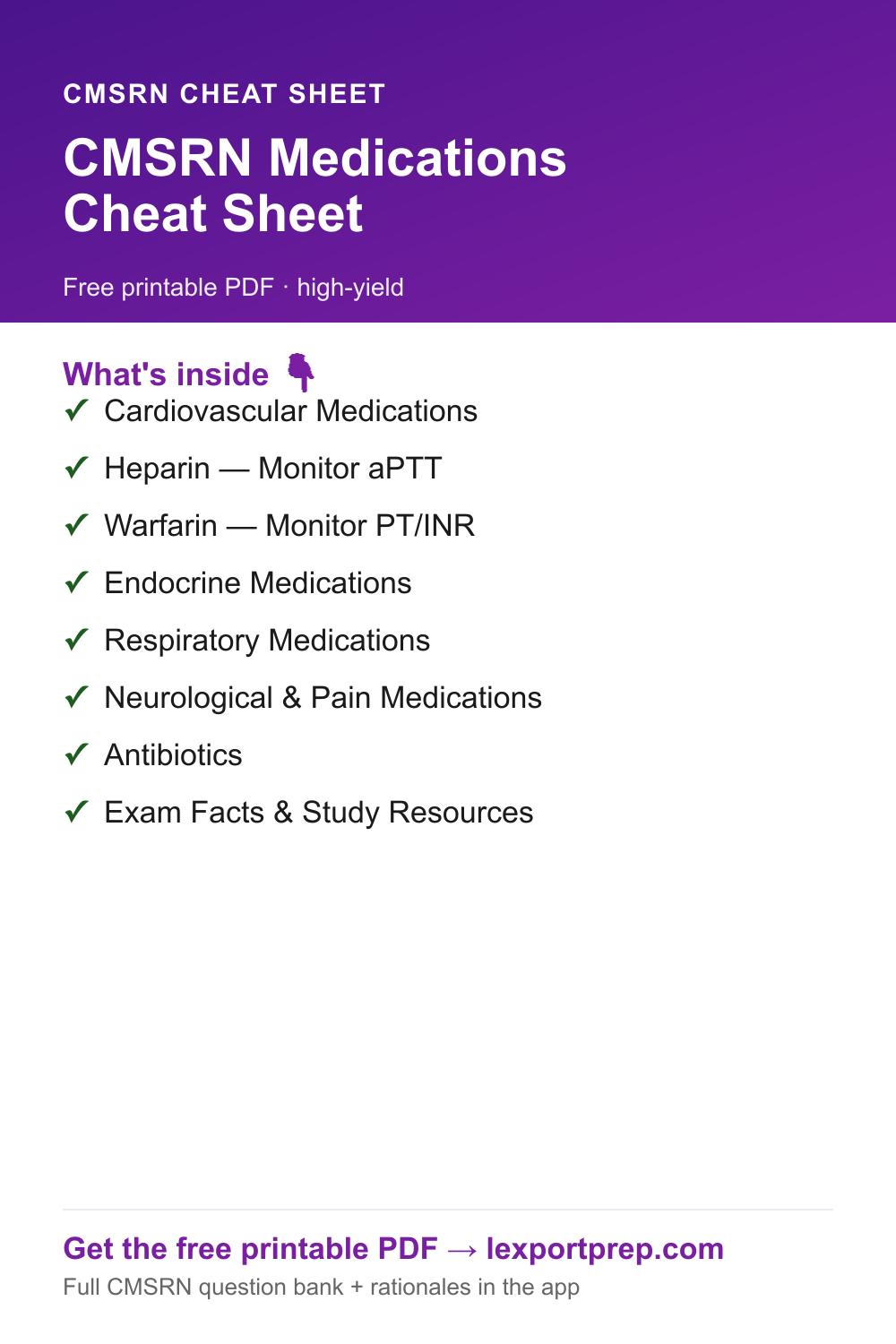
πŸ“Œ Save or share this CMSRN cheat sheet
CMSRN Medications Cheat Sheet β€” free printable quick-reference chart

Can you apply it?

Knowing the sheet and using it are different things. Try these three CMSRN practice questions on medications. The app has 5,200+, timed and scored.

Question 1

A postoperative patient reports taking "a blue pill for blood pressure" at home. The nurse finds amlodipine 5mg in their EHR history but the patient's home medication bottle shows lisinopril 10mg. The admission team documented amlodipine. Which reconciliation step is most accurate?

β–Έ Why D is the answer

Discrepancies between patient report, labels, and records require direct patient engagement. Option A risks error if the bottle is outdated. Option B delays care and violates HIPAA if unauthorized. Option C creates therapeutic duplication. Option D uses visual verification (pill pictures) to resolve conflicts per ISMP best practices, especially crucial with vague patient descriptions and conflicting sources in reconciliation.

Question 2

A diabetic patient with uncontrolled hypertension admits missing medications due to choosing between groceries and prescriptions. The spouse recently lost their job, and the patient tearfully states, "I'm too ashamed to ask for help." Which collaborative approach aligns with trauma-informed care principles?

β–Έ Why B is the answer

Financial toxicity and expressed shame indicate psychosocial distress requiring sensitive intervention. Social workers specialize in resource linkage while addressing emotional barriers through therapeutic engagement. Option A offers passive resources without addressing shame. Option C/D focus on education/navigation but ignore the patient's emotional vulnerability. AMSN guidelines emphasize trauma-informed collaboration when stigma affects care access, prioritizing both practical and emotional support.

Question 3

A medication safety project identifies look-alike sound-alike (LASA) errors between hydralazine and hydroxyzine. Pharmacy has relabeled storage bins, but errors persist during night shifts. Which risk management strategy is most effective?

β–Έ Why B is the answer

Barcode scanning addresses the persistent point-of-failure (cue: errors during administration) and compensates for human factors in low-light conditions (cue: night shifts). Option A increases workload without eliminating errors. Option C may cause alert fatigue. Option D doesn't prevent selection errors. Scanning provides real-time verification per ISMP guidelines for high-risk LASA mitigation.

Unlock all 5,213 CMSRN practice questions, including 37 full-length mock exams

Timed, scored, with progress tracking and every answer explained. Free to start.

Practice the full CMSRN bank in the app

You've seen a sample. Get the complete experience β€” a timed exam simulator, every rationale, and progress tracking that shows exactly what to study next.

This page shows a few free samples. The app has all 5,200+ CMSRN questions, a timed mock exam, and offline study.

β˜…β˜…β˜…β˜…β˜…4.6 Β· 22 App Store ratings
  • βœ“ 5,200+ real CMSRN questions
  • βœ“ Timed exam simulator β€” real conditions
  • βœ“ Every answer explained + key takeaway
  • βœ“ Tracks your weak topics
  • βœ“ Works offline Β· Free to start

Get the full CMSRN question bank β€” free

5,200+ practice questions with rationales on iOS & Android

CMSRN Β· Exam Simulator

Sample exam question…

A) Option A
B) Option B
C) Option C
D) Option D
Submit Answer